OCMPAC - Research and Monitoring
Vital to the success of Marine Protected Areas (MPAs) is biological and ecological research, particularly research that improves our understanding of determining the success of MPA designation. Ecosystem Based Management (EBM) is particularly important as we move away from simply protecting intertidal populations and move towards understanding how these ecosystems function so that we can better understand how to efficiently conserve our coasts. Without experimental research and monitoring, the effectiveness of MPAs could not be studied.Research Permits
The City of Newport Beach, City of Laguna Beach, City of Dana Point, Crystal Cove State Park, and Orange County maintained beaches may require you to obtain various permits prior to conducting research or bringing your class to the intertidal habitat. The intent of the permit is to ensure visitor safety and reduce impacts to the intertidal habitat. Below is a reference to the types of research permitted as well as the contact information for local area managers.
NOTE: Area managers only exercise authority within their jurisdiction. If your research spans multiple cities or jurisdictions, then you may need to notify multiple area managers.
Conducting Observational Only Research
Includes use of research methods such as transects, quadrats, timed counts, size measurements, and species identification.
If you are taking a class to and/or conducting research within Orange County MPAs, you must contact the associated state marine reserve, park, or conservation area manager prior to your visit. A list of area managers can be found below.
NOTE: Collecting of any type of data (even if animals are not collected) is considered research and requires a Scientific Collection Permit (SCP) from the California Department of Fish and Wildlife and permission from the appropriate MPA manager. Under no case can organisms be collected for exhibition or classroom use.
Conducting Research Involving Manipulation to the Environment
Includes collection or handling of macrophytes, animals, shells, rocks, or water, OR manipulation of natural biota or substrate for collection. “Collecting” includes picking up organisms, even if they are returned to the intertidal and not removed from the site.
Collecting of any material, alive or dead, within MPAs is illegal unless you have a valid Scientific Collecting Permit (SCP) from the California Department of Fish and Wildlife (CDFW) and permission from the appropriate MPA manager. Some park or conservation area managers have a seperate permitting process in addition to permits required by CDFW. Access is at the discretion of the land manager. Please contact the appropriate land manager listed below for more information.
You are required to notify the local CDFW field office 24 hours before collecting:
- Los Alamitos Office
- 4665 Lampson Avenue, Suite C, Los Alamitos, CA 90720
- (562) 342-7100
- Fax (562) 596-0342
All collections must directly relate to your permitted research and to the geographical area of focus. Collections authorized under the authority of a SCP that are for the purpose of generalized study or classroom lab work must be obtained from outside the Marine Protected Area Network.
Failure to follow these regulations may result in fines and/or revocation of collection or research privileges in that Marine Protected Area.
K-12 School Groups
There are a number of programs available to instructors of K-12 school groups looking to augment classroom learning with field studies. Learn how to bring your school group to Orange County’s Marine Protected Area Tide Pools.
Submit a Category One Research Use Form to Notify Area Managers
You may be required to notify local area managers prior to conducting your research using a Category One Research Use form. Click the buttons below to download the document in a PDF or Word format. Submit a completed form to the area managers listed below.
Area Managers

City of Laguna Beach

City of Newport Beach
Contact

City of Dana Point
Bernie Villanueva-Grzecka
Natural Resources Protection Officer
(949) 248-3527
Crystal Cove State Park
Riley Pratt
Senior Environmental Scientist
Additional Permit Required: State Parks Scientific Research and Collecting Permits

County of Orange
Contact
California Department of Fish and Wildlife
Los Alamitos Office
4665 Lampson Avenue, Suite C, Los Alamitos, CA 90720
(562) 342-7100
Fax (562) 596-0342
Ongoing Monitoring in Orange County MPAs
Multi-Agency Rocky Intertidal Network (MARINe)
In 1996, the Multi-Agency Rocky Intertidal Network (MARINe) established four locations in Orange County (Shaw’s Cove, Treasure Island, Crystal Cove, and Dana Point) to monitor the abundances of target species. This network (http://www.pacificrockyintertidal.org/), funded by various organizations including the Bureau of Ocean Energy Management within the US Department of Interior, spans across the California and Oregon coast encompassing 80 sites. For Orange County locations, California State University, Fullerton is currently monitoring the abundance of mussels (Mytilus), rockweeds (Silvetia), barnacles (Chthamalus and Balanus), red algal turfs (Endocladia), surf grasses (Phyllospadix), owl limpets (Lottia), sea stars (Pisaster), and other important flora and fauna. Surveys of these areas are conducted every 6 months to a year, beginning in 1996 and continuing through the present. To see the results of the long-term monitoring for the Orange County sites, visit the links below.
- Crystal Cove
- Shaw’s Cove
- Treasure Island
- Dana Point
State-Led Baseline and Long-term MPA Monitoring
To monitor California’s MPAs, CDFW, OPC, and the Fish and Game Commission collaboratively direct the MPA Monitoring Program. The program includes a two-phased, ecosystem-based approach: Baseline Monitoring and Long-Term Monitoring. Baseline Monitoring occurred from 2007-2018, and current Long-Term Monitoring projects are funded from 2019-2022.
- State of the California South Coast – Summary of Findings from Baseline Monitoring of Marine Protected Areas, 2011 – 2015
- Synthesis of previous and ongoing MPA Research and Monitoring by California Sea Grant
MPA Watch
MPA Watch is a network of programs that support healthy oceans through community science by collecting human use data in and around our protected areas. Volunteers monitor all human uses in MPA’s including resting and games, running, walking, fishing, swimming, surfing, boating, diving, and interacting with local tide pools. Links to local programs below.
Snapshot Cal Coast
Several Orange County groups participate in Snapshot Cal Coast. Snapshot Cal Coast is an annual California statewide citizen science effort that encourages people to make and share observations of plants, animals, and seaweeds along the California coast using the iNaturalist app. The goal of these events is to obtain a baseline snapshot of biodiversity along the California coast that will be useful for scientists and natural resource managers at local, regional, and state levels. We also build a community of observers and recorders interested in documenting California coastal biodiversity and answer targeted research questions in support of California MPAs.
Orange County and Catalina Island Abalone: Mapping of Existing Abalone and Habitat Datasets
Research was conducted by Blue Earth Consultants, a Division of Eastern Research Group, Inc. (Blue Earth) regarding abalone populations and abalone habitat off the coasts of Orange County and Catalina Island. Their report provides a synthesis of stakeholder recommendations for future actions relating to abalone research and restoration, outreach and education, and enforcement in several geographic focal areas along the coasts of Orange County and Catalina Island. For more information contact OCMPAC Co-Chairs listed here.
Owl Limpet Monitoring
An owl limpet monitoring community science program was initiated at Dana Point and OCMPAC members are continuing this monitoring in Crystal Cove and attempting to expand this program to include other Orange County locations.
OCMPAC Member Research

UCI Marine Biodiversity Lab
Led by Matthew Bracken, Ph.D., our lab group, based in the Department of Ecology and Evolutionary Biology at the University of California, Irvine, uses an interdisciplinary approach to evaluate the linkages between marine communities and ecosystems.

UCI Sorte Lab
Cascade Sorte, Ph.D. Associate Professor, Department of Ecology and Evolutionary Biology, UC-Irvine. Research in the Sorte Lab focuses on the impacts of global change in coastal marine systems, particularly the consequences of climate change, range shifts, and species invasions.
Jennifer Burnaford, Ph.D.
Research areas: Marine community ecology, species interactions, abiotic factors influencing species distributions
MBC Aquatic Sciences
At MBC, we partner closely with our clients to get their projects approved and keep them sustainable. No matter the physical or monetary consideration, MBC is there to offer the experience and care that every stakeholder in the aquatic environment deserves. From providing thorough analysis and accurate reports for regulatory approval to sustainability monitoring – we try to exceed our clients’ expectations while protecting the environment.
Jayson Smith, Ph.D.
I am a marine conservation ecologist with particular interest in anthropogenic disturbances on ecosystem functioning and community structure of coastal habitats. Given the high population of humans in southern California, urban coastal ecosystems are subjected to numerous human impacts. Work in my lab attempts to understand how these systems are changing and functioning in the face of these disturbances.
Orange County Coastkeeper
We work collaboratively with diverse groups in the public and private sectors to achieve healthy, accessible, and sustainable water resources for the region. We implement innovative, effective programs in education, advocacy, restoration, research, enforcement, and conservation.
Media and Publications

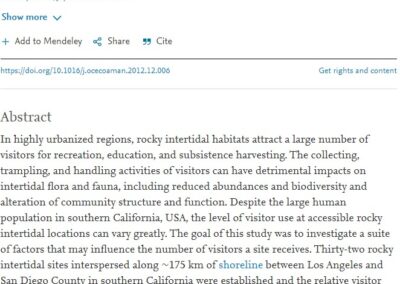
Evaluation of two outreach tools, an educator program and a mobile tidepool exhibit, in reducing deleterious visitor activities and raising marine protected area awareness in rocky intertidal ecosystems of southern California, USA

In-kind contributions to Orange County marine protected area management

Sea star wasting disease is still a mystery, but CSUF researchers are on the case

How California’s sea stars are evolving past a devastating pandemic

Large-scale impacts of sea star wasting disease (SSWD) on intertidal sea stars and implications for recovery.

A hunt for the invasive dark unicorn snail shows UCI students how climate change is altering Crystal Cove tide pools

Signs of success for marine-protected areas off PV, Catalina

Alterations in human visitation patterns and behaviors in southern California rocky intertidal ecosystems over two-decades following increased management efforts

The putative impacts of the non‐native seaweed Sargassum muticum on native communities in tidepools of Southern California and investigation into the feasibility of local eradication

The non-native turf-forming alga Caulacanthus ustulatus displaces space-occupants but increases diversity