Tuesday, January 28, 2025
10:00 am - 1:00 pm
,
For more info
Contact:
Adrian Laufer, adrian@sea-shoresolutions.com
Additional Info
Map Unavailable
Event Details
* Important Update: Our initially planned RVA (Rapid Vulnerability Assessment) December and January workshops were rescheduled due to the tsunami warning. Please see below for updated information.*
RVA Workshops Overview:
For those of you who are closely familiar with Pillar Point and Montara MPAs in San Mateo County, there is a unique opportunity to participate in a climate change rapid vulnerability assessment (RVA) of the MPAs.
We ask that you commit to joining both of the RVA Workshops, both of which will do a deep dive into the RVA. If you join the subgroup, you will then be provided additional information regarding the workshops such as reading materials, a recording of the RVA presentation from 11/2024 at the San Mateo MPA Collaborative Meeting, and additional RVA resources. Both workshops will be held virtually on Zoom.
Workshop #1: Jan. 28 10am-1pm, Pacific
Workshop #2: Feb. 6 10am-12pm, Pacific
→ Please contact Adrian Laufer (adrian[at]sea-shoresolutions.com) if you are interested in learning more or participating.
MPA Central Coast Specialist, Krystle Ramos, and the San Mateo MPA Co-Chairs, Natalie Downe and Marina Luccioni, are supporting this project.
FAQs
The workshops are intended for all stakeholders (community members, government agencies, NGOs, academia, students, to name a few) who are closely familiar with both Pillar Point and Montara MPAs. If you are unsure if you should join, feel free to reach out to Adrian Laufer (adrian[at]sea-shoresolutions.com) to see if the subgroup is a fit for you.
What is a RVA?
A RVA is a simple method for MPA managers and community members to better understand habitat vulnerability to climate impacts and the potential for climate-informed management to reduce vulnerability. Vulnerability assessments are an important tool for natural resource managers, as they provide insight into which resources are likely to be most affected by changing climate conditions, which informs priorities for management, and why these resources are likely to be vulnerable, which provides a basis for developing appropriate management responses (Glick et al. 2011, Brundell et al. 2011).
Who is Conducting the RVA?
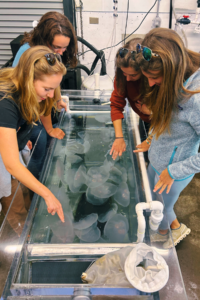
Sea & Shore Solutions will be conducting the RVA workshops.
Who is Sea & Shore Solutions?
From the Sea & Shore Solutions website:
Sea & Shore Solutions team
Sea & Shore Solutions is a certified women-owned environmental consulting firm focused on creating and implementing innovative solutions to support meaningful coastal management and marine policy. Our team thrives in the space between science and application through management, policy, outreach, and technology solutions. We leverage expertise in natural sciences, GIS, policy, communications, and environmental management to support a diversity of ocean-minded organizations. Through a highly transparent and organized approach, S&S provides specialized operational capacity to clients, ensuring that priorities and timelines are efficiently met. Our deep experience in coastal and ocean fields allows us to offer efficient and applied approaches to help make connections, identify unique approaches, and develop lasting solutions. We approach each project with a dedication to innovation, utilizing new processes and technologies to push the boundaries and improve coastal and marine environments in new ways.
Why is there a RVA being conducted? Why in San Mateo?
Sea & Shore Solutions is a recipient of our 2024 Climate + MPAs Microgrant. Their proposal seeks to address community concerns, needs, and recommendations that were compiled and published in the San Mateo MPA Collaborative Climate Summary Report, which captures the perspectives and experiences that local community members provided to MPA Collaborative Network in 2023.
This assessment methodology enables investigation of habitats, species, communities, and other resources related to MPAs. This project will enable initial scoping of this approach through the exploration of 2 specific resources of interest and 2-3 related climate impacts. The results can be utilized directly by decision makers and stakeholders, and will also serve as a valuable case study to develop and implement CCVA methods that can later be replicated at a larger scale across the MPA Collaborative Network.