Our Purpose
The purpose of the MPA Collaborative Network is to ensure and support a cooperative and just structure that encourages participation in decision-making processes, grounded in the values of respect for differences and the interconnection between humans and nature.
Mission & Vision
The mission of the MPA Collaborative Network is to empower diverse communities to engage in marine protected area stewardship for a healthy ocean. The vision of the MPA Collaborative Network is to ensure the health and sustainability of our natural and social environments through civic engagement in local marine management and stewardship.
What Makes Us Who We Are

Commitment to Diversity
We commit to providing pathways for active participation in marine management and stewardship from all identities including but not limited to gender, sexual orientation, race, ethnicity, national origin, ability, socioeconomic status, marital status, age, education level, culture, religion, and background.
This includes actively acknowledging past and present injustice and ongoing oppression. We recognize there are barriers to engaging based on these identities. We believe building relationships based on mutual respect will allow us to collectively listen, make decisions, and act together to effect positive change and commit to providing a structure where these diverse ideas and perspectives are not only heard but valued. We acknowledge that societal and ecological health cannot be achieved without the inclusion and leadership of diverse peoples and voices.
Our goal is to embed, build, ensure, and track equity throughout the MPA Collaborative Network and encourage partners to do the same. We aim to do so by supporting the engagement, leadership, initiatives, and self-determination of marginalized peoples. We acknowledge this work is an ongoing process and commit to continual evolution.

Community Guidelines
- Practice mutual respect
- Create a safe space (confidentiality, kindness)
- One voice at a time
- Assume positive intent. Acknowledge harmful impact.
- Disagree without disrespect (no shaming or blaming)
- Listen to understand
- Speak from your own experience, not on behalf of others or as generalizations
- Provide appreciations
- No one knows everything – together we know a lot

Core Values
Seven Core Values will guide the decisions and actions of the members of the CN moving forward:
1. Facilitating the sharing of diverse ideas and perspectives
2. Encouraging active participation from people of all identities including but not limited to gender, sexual orientation, race, ethnicity, national origin, ability, socioeconomic status, marital status, age, education level, culture, religion, colonial foundation, and background.
3. Advancing an anti-racist and decolonizing ethic that supports individual and collective agency, tribal sovereignty, self-determination, traditional environmental management practices, and the dismantling of barriers
4. Listening, making decisions, and acting together
5. Developing mutual respect
6. Building relationships
7. Affecting positive change

Beliefs
- A healthy ocean is vital to life on Earth
- We cannot separate ourselves from our core values; all change must occur within the context of our core values
- We can achieve more working together
- We are part of our natural environment
- We can learn from each other’s unique historical perspectives and experiences, especially from Indigenous peoples who built societies that were sustainable for thousands of years
- Balance is needed, socially and ecologically, to ensure sustainability
- We belong to multiple diverse communities, cohorts, Nations, and ecosystems all of which are interconnected and make us who we are
- There is no such thing as true objectivity/neutrality – we are products of our environment and experiences
- There are more ways we are similar than there are ways we are different
Shifting baselines affects our perceptions
These elements of our Strategic Plan were reviewed and updated to better reflect our organization as of January 2023.
Why the MPA Collaborative Network?

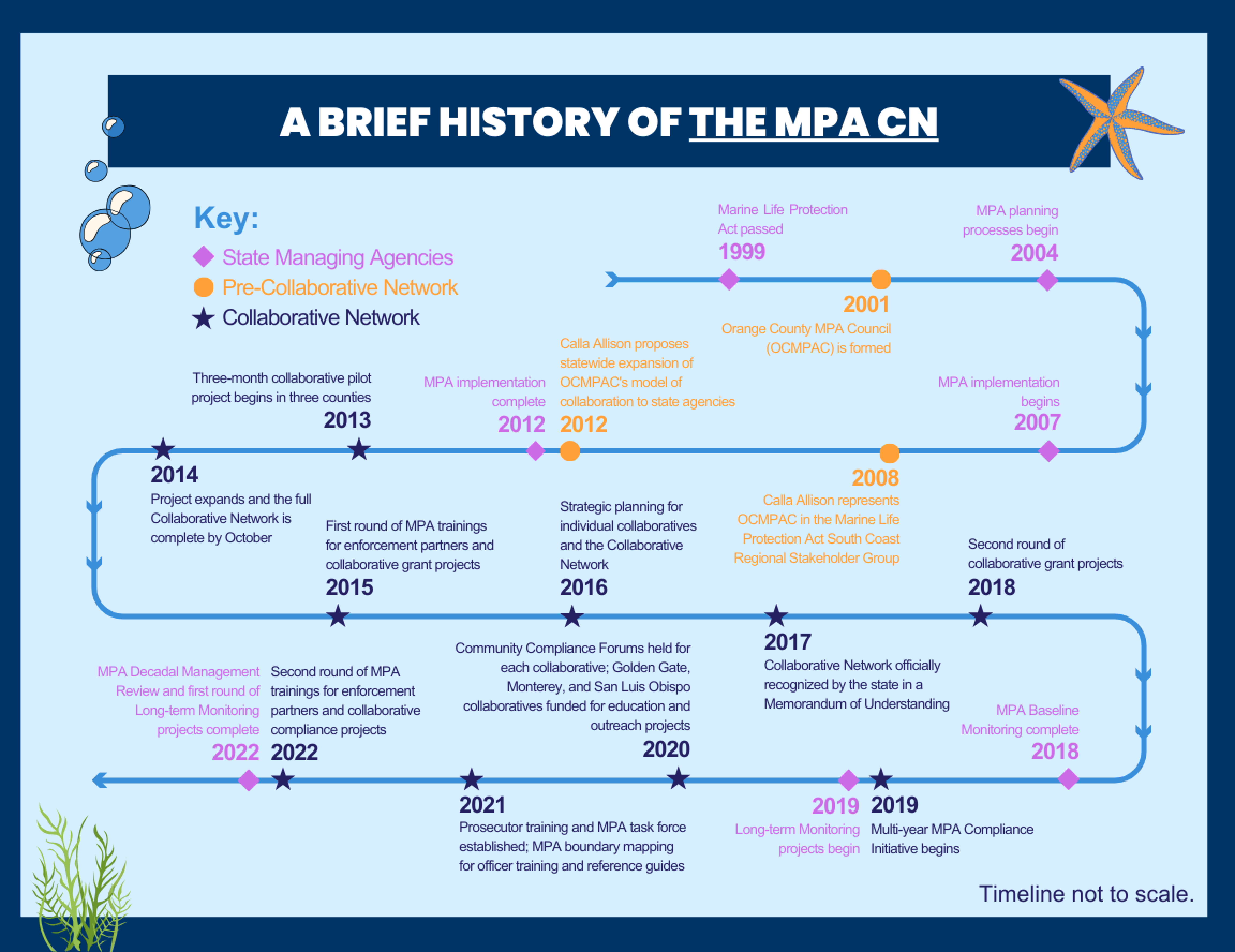
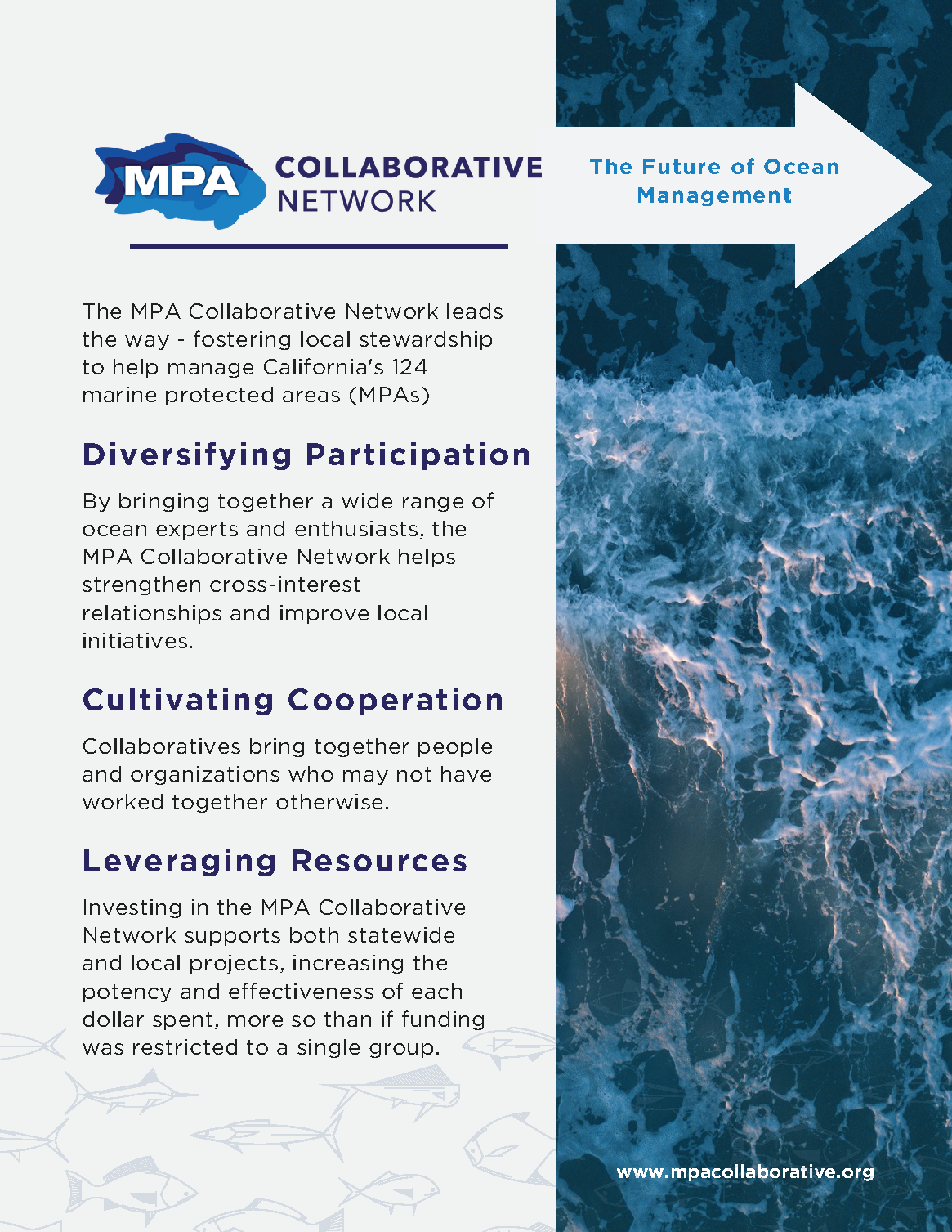
In 2012, California implemented a world-class system of 124 marine protected areas (MPAs), created through a comprehensive stakeholder-led public process. During this process, Calla Allison, MPA Collaborative Network Founder and Executive Director, served as a stakeholder in the creation of South Coast MPAs and a representative of the Orange County Marine Protected Area Council (OCMPAC), which was the very first group established to unite experts to collaboratively manage local MPAs. Seeing firsthand this model’s success, Allison proposed replicating it on a county-by-county basis.
Rather than the state providing a structure for engagement, collaborative members develop it themselves. This leads to more buy-in and resource-sharing from local organizations. The MPA Collaborative Network also allows state agencies to respond to requests for structure and input, rather than feeding it from the top-down.
The MPA Collaborative Network is a nonprofit 501(c)(3) organization.
Oceans of Vision: The Story of Our Founder
The MPA Collaborative Network was founded by Calla Allison
In 2012, California implemented a world-class system of 124 marine protected areas (MPAs), created through a comprehensive stakeholder-led public process.
Collaborative Network Director Calla Allison identified an opportunity to ensure that locals were involved in the management of their MPAs: developing a bottom-up, localized, and participatory approach to resource management—the MPA Collaborative Network.
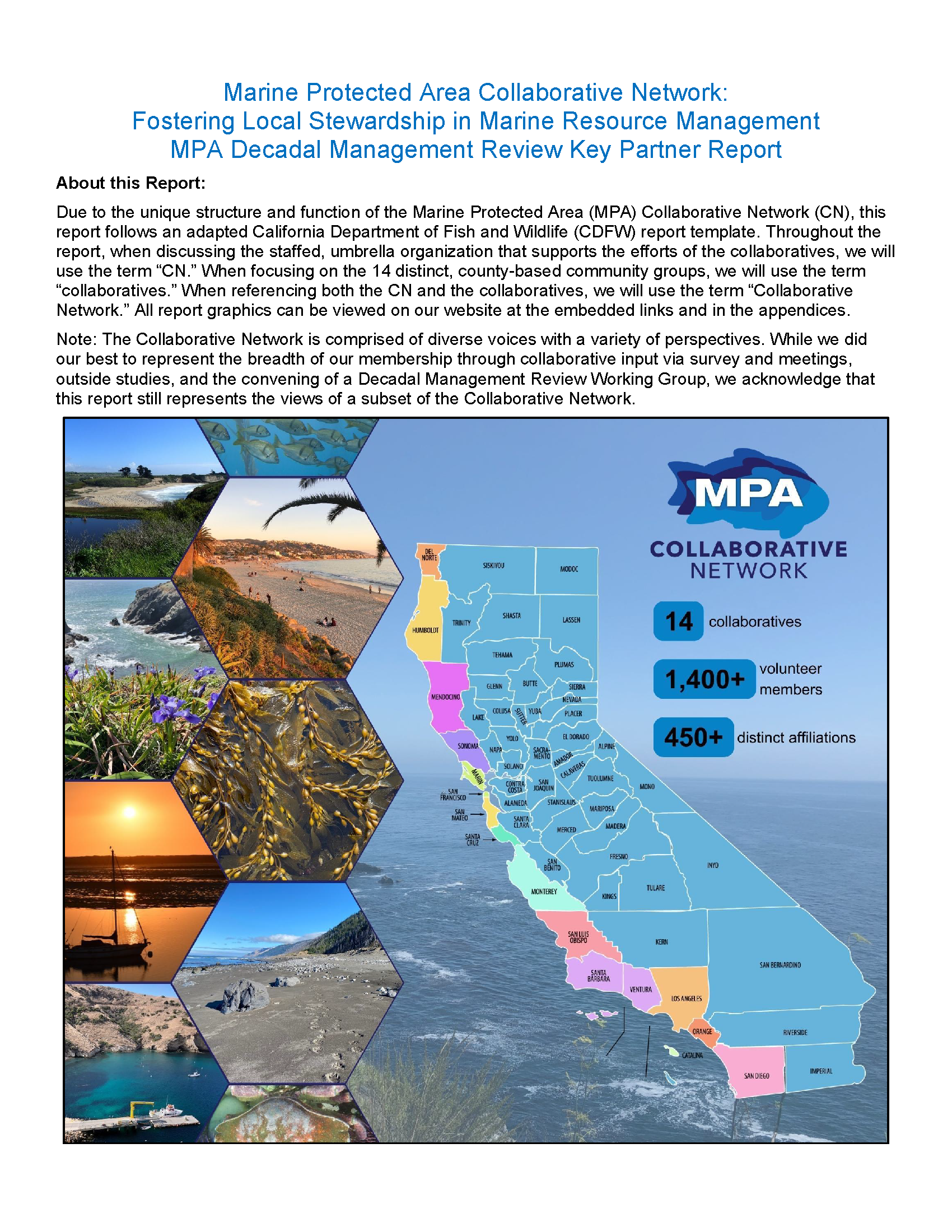
Allison began organizing local stakeholders in the San Mateo, San Diego, and Santa Barbara counties in 2012. Local stakeholders and MPA experts quickly planned meetings to identify existing resources and propose projects to increase local awareness of MPAs. Based on the success of these groups, Allison led the development of the MPA Collaboratives, which accounted for each of California’s coastal counties.
The development of these MPA Collaboratives was supported by the California Natural Resources Agency (CNRA) and the California Department of Fish and Wildlife (CDFW), and funded by Resources Legacy Fund (RLF).
Learn More
Thank You to Our Funders!